CouchDB Tutorial: Learn Document Database from Scratch (2026)
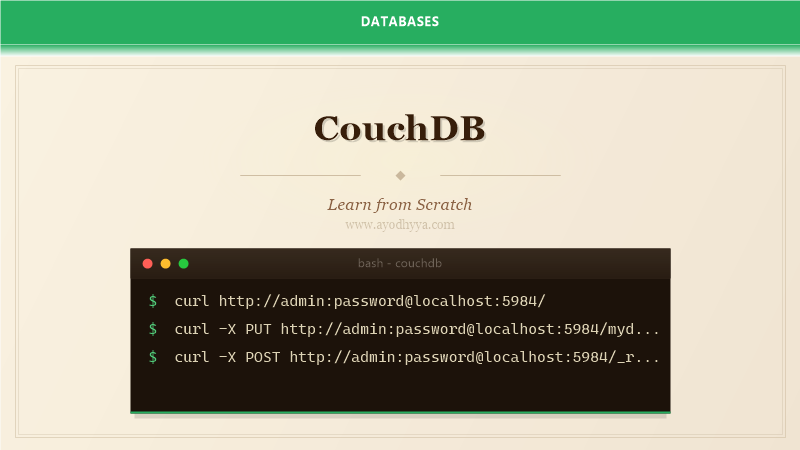
I have built applications on top of CouchDB for years, and what I appreciate most is how it embraces the web architecture instead of fighting it. CouchDB stores JSON documents, exposes a RESTful HTTP API, and uses MapReduce for queries.
We will cover installation, document CRUD via HTTP, design documents with MapReduce views, replication between nodes, and conflict resolution.
Installing CouchDB and Understanding the Architecture
CouchDB runs on all major platforms. On Debian or Ubuntu, add the Apache CouchDB package repository and install via apt. On Windows, use the official installer. The server listens on port 5984. Fauxton is available at http://localhost:5984/_utils.
CouchDB architecture is built around append-only B-tree storage and MVCC. Every update creates a new revision, eliminating locking during reads and enabling multi-master replication.
curl http://localhost:5984/
curl -X PUT http://admin:password@localhost:5984/mydb
CRUD Operations with REST API
CouchDB is fundamentally a JSON document store accessed through HTTP. You create, read, update, and delete documents using PUT, GET, POST, DELETE. This makes it trivial to work with from any language.
Documents have _id and _rev fields. The _rev is required for updates and deletes. If you supply a stale _rev, CouchDB returns 409 Conflict.
curl -X PUT http://admin:password@localhost:5984/mydb/user-alice -H "Content-Type: application/json" -d '{"_id": "user-alice", "name": "Alice", "role": "admin"}'
curl http://admin:password@localhost:5984/mydb/user-alice
Design Documents and MapReduce Views
Queries in CouchDB are built using MapReduce views inside design documents. The map function emits key-value pairs, and the reduce function aggregates them. Views are indexed incrementally as documents change.
When you query a view, results are sorted by key. Use startkey, endkey, limit, and skip for pagination. The key design decision is choosing the right key structure.
{"_id": "_design/users", "views": {"by_role": {"map": "function(doc) {
  if (doc.role) {
    emit(doc.role, doc.name);
  }
}"}}, "language": "javascript"}
Replication and Multi-Master Clustering
CouchDB replication is multi-master: you can write to any node, and changes propagate asynchronously. Replication can be continuous or one-shot over HTTP.
When the same document is edited on two nodes before replication, CouchDB creates a conflict tree. The winning revision is chosen deterministically, but conflicted revisions are stored.
curl -X POST http://admin:password@localhost:5984/_replicate -H "Content-Type: application/json" -d '{"source": "http://admin:pass@localhost:5984/mydb", "target": "http://admin:pass@remote:5984/mydb"}'Conflict Detection and Resolution
CouchDB surfaces conflicts through the _conflicts field listing conflicted revision IDs. To resolve, fetch all conflicted revisions, merge, and PUT the new revision with the correct _rev.
Automated conflict resolution policies like last-writer-wins or custom merge functions can be implemented on the application side.
curl http://localhost:5984/mydb/mydoc?open_revs=["3-def","4-ghi"]
curl -X PUT http://localhost:5984/mydb/mydoc -d '{"_rev": "4-ghi", "merged": true, "field": "value"}'
Performance Tuning and Production Deployment
Scaling CouchDB requires attention to key levers. The maximum database size is governed by disk and B-tree depth. CouchDB 3.x has built-in sharding.
Compaction reclaims space from deleted documents and old revisions. Set auto-compaction intervals based on your churn rate. Monitor /_node/_stats endpoints.
[couchdb]
max_dbs_open = 100
[compaction]
_default = [{db_fragmentation, "70%"}, {view_fragmentation, "60%"}]
curl http://admin:password@localhost:5984/_node/_local/_stats
Frequently Asked Questions
What is the difference between CouchDB and MongoDB?
CouchDB prioritizes multi-master replication and offline-first capabilities. MongoDB offers richer query operators and stronger consistency within a cluster.
Can CouchDB handle full-text search?
Not natively. Pair CouchDB with Dreyfus (Bleve) or use a separate Elasticsearch cluster consuming the _changes feed.
How do I authenticate users in CouchDB?
CouchDB supports basic auth, cookie-based sessions, and proxy authentication. User documents are stored in the _users database.
Is CouchDB ACID compliant?
CouchDB provides atomicity and durability at the document level. Multi-document transactions are not supported; embed related data in a single document.
Originally published on Ayodhyyya. Last updated June 1, 2026.