InfluxDB Tutorial: Learn Time-Series Database from Scratch (2026)
I have used InfluxDB to store billions of time-series data points across IoT sensor networks, application monitoring, and financial tick data. It is purpose-built for time-stamped data that traditional databases handle poorly.
We will cover the InfluxDB data model, InfluxQL, retention policies, continuous queries, downsampling, and production cluster management.
Understanding the InfluxDB Data Model
InfluxDB data model: measurement (like a table), tags (indexed metadata), fields (actual numeric values), and timestamp. Tags are used for filtering and grouping.
High-cardinality tag values degrade performance. Put user IDs and emails in fields, not tags. Limit tag cardinality to under a few million unique values per measurement.
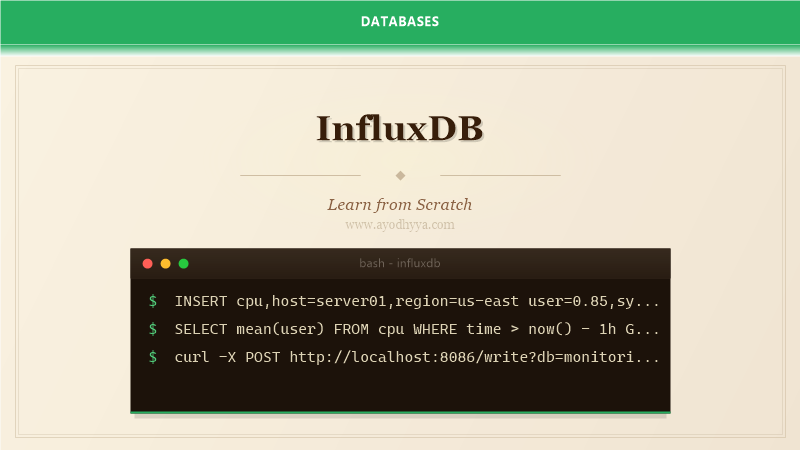
INSERT cpu,host=server01,region=us-east user=0.85,system=0.12,idle=99.03 1719331200000000000
INSERT cpu,host=server02,region=us-west user=0.45,system=0.08,idle=99.47 1719331200000000000
CREATE DATABASE monitoring
SHOW MEASUREMENTS
Querying with InfluxQL
InfluxQL supports standard SQL plus time-specific functions: derivative(), difference(), moving_average(), cumulative_sum(). GROUP BY time() creates time buckets.
Use relative time ranges like WHERE time > now() - 1h or absolute ISO 8601 timestamps.
SELECT mean(user) AS avg_cpu FROM cpu WHERE time > now() - 1h AND region = 'us-east' GROUP BY time(10m), host
SELECT derivative(mean(user), 1m) AS rate_per_min FROM cpu WHERE time > now() - 6h GROUP BY time(5m), host
Retention Policies and Continuous Queries
Retention policies define how long data is kept. Each database has a default RP called autogen. Multiple RPs with different durations can exist.
Continuous queries automatically downsample data at specified intervals, computing hourly averages from raw minute-level data for long-term storage.
CREATE RETENTION POLICY "one_hour" ON monitoring DURATION 1h REPLICATION 1 DEFAULT
CREATE RETENTION POLICY "one_year" ON monitoring DURATION 365d REPLICATION 1
CREATE CONTINUOUS QUERY "cq_hourly_avg" ON monitoring BEGIN SELECT mean(user) AS avg_user INTO monitoring.one_year.cpu_hourly FROM monitoring.one_hour.cpu GROUP BY time(1h) END
Writing and Reading Data at Scale
Use line protocol over HTTP for maximum write throughput. Batch multiple points in a single POST. InfluxDB supports gzip compression for reduced bandwidth.
Always include a time range in queries to restrict to relevant shards. Use LIMIT and OFFSET for pagination. Materialize frequent aggregations with continuous queries.
curl -X POST http://localhost:8086/write?db=monitoring --data-binary @data.txt
SELECT * FROM cpu WHERE time > now() - 1h LIMIT 1000 OFFSET 2000
Downsampling and Data Retention Strategies
A well-designed downsampling strategy reduces storage by 90%+. Keep raw data for hours, minute-averages for days, hour-averages for months, daily aggregates forever.
Shard group duration matters: shorter improves data expiry but increases metadata overhead. Design the granularity ladder matching your query patterns.
CREATE CONTINUOUS QUERY "cq_1m" ON monitoring BEGIN SELECT mean(user) AS avg_user INTO monitoring.autogen.cpu_1m FROM monitoring.autogen.cpu GROUP BY time(1m), * END
CREATE CONTINUOUS QUERY "cq_1h" ON monitoring BEGIN SELECT mean(user) AS avg_user INTO monitoring.one_year.cpu_1h FROM monitoring.autogen.cpu_1m GROUP BY time(1h), * END
InfluxDB Clustering and High Availability
InfluxDB OSS is single-node. For HA and horizontal scaling, use InfluxDB Enterprise or Cloud. Enterprise uses meta-nodes for cluster management.
Three meta nodes (odd for consensus) and at least two data nodes are recommended. Anti-entropy service repairs shard inconsistencies.
[meta]
  enabled = true
  bind-address = ":8088"
[data]
  dir = "/var/lib/influxdb/data"
  wal-dir = "/var/lib/influxdb/wal"
Frequently Asked Questions
Is InfluxDB free to use?
InfluxDB OSS is free under MIT. Enterprise requires a commercial license. Cloud offers a free tier with limited capacity.
Can I use SQL instead of InfluxQL?
InfluxDB 3.x supports SQL. 2.x uses Flux. 1.x uses InfluxQL. Check your version and choose accordingly.
What are tags vs fields in InfluxDB?
Tags are indexed metadata strings for filtering. Fields are non-indexed numeric values. High-cardinality data should be fields.
How do I handle duplicate data points?
If a point has the same measurement, tag set, and timestamp as an existing point, it overwrites the field values. Timestamp is the deduplication key.
Originally published on Ayodhyyya. Last updated June 1, 2026.