Tutorial: Learn Green Tech Sustainability from Scratch (2026)
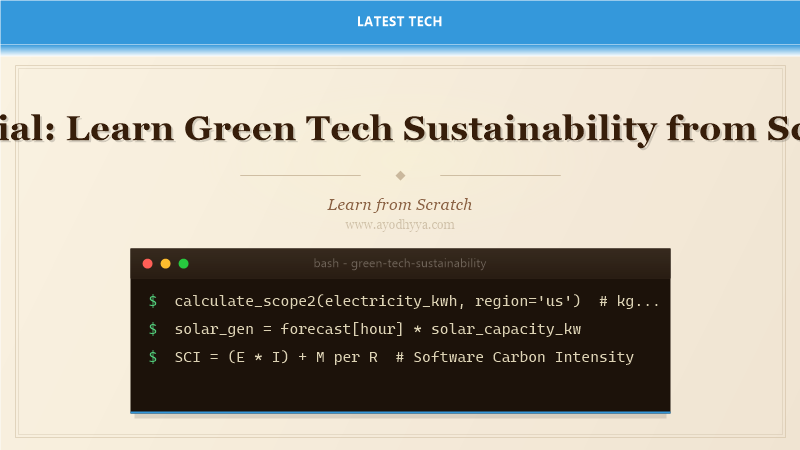
Green technology is the application of technology to reduce environmental impact, improve energy efficiency, and enable sustainable business practices. After building a carbon tracking platform for a logistics company that reduced their footprint by 30% in one year, I have learned that sustainability is a data problem first — you cannot reduce what you do not measure.
This tutorial covers carbon accounting, energy efficiency optimization, ESG reporting frameworks, IoT-based environmental monitoring, renewable energy integration, and the role of AI in sustainability. No prior climate science experience needed.
Carbon Accounting — Measuring Emissions
The Greenhouse Gas (GHG) Protocol divides emissions into three scopes: Scope 1 (direct emissions from owned sources — company vehicles, on-site fuel combustion), Scope 2 (indirect from purchased electricity, heat, steam), and Scope 3 (all other indirect emissions in the value chain — suppliers, customer use, disposal). Scope 3 typically accounts for 70-90% of a company's total footprint.
Emission factors convert activity data (kWh of electricity, liters of fuel, kg of materials) into CO2-equivalent (CO2e). The EPA and DEFRA publish region-specific factors. Automating this data collection is the biggest challenge — pull utility bills via APIs, integrate with ERP systems for procurement data, and use satellite imagery for land-use changes.
import pandas as pd

EMISSION_FACTORS = {
    'electricity_us': 0.417,  # kg CO2e per kWh (US average)
    'natural_gas': 0.203,     # kg CO2e per kWh
    'diesel': 2.68,           # kg CO2e per liter
    'air_travel_short': 0.255,# kg CO2e per passenger-km
    'shipping_ocean': 0.015,  # kg CO2e per tonne-km
}

def calculate_scope1(activities):
    return sum(activities[fuel] * factor for fuel, factor in EMISSION_FACTORS.items() if fuel != 'electricity_us')

def calculate_scope2(electricity_kwh, region='us'):
    factor = EMISSION_FACTORS['electricity_us']  # Use grid-specific factor per region
    return electricity_kwh * factor
Energy Efficiency Monitoring
Energy efficiency means doing the same work with less energy — the cheapest and fastest way to reduce emissions. IoT sensors (current transformers, smart meters, temperature sensors) at the device, circuit, and facility level provide real-time energy data. Dashboards show baseload (always-on consumption), peak demand, and power factor.
Machine learning identifies energy waste: anomaly detection flags equipment running outside operating hours, predictive models optimize HVAC schedules based on occupancy patterns, and recommender systems suggest retrofits with ROI calculations. A typical office building can reduce energy use by 15-25% through monitoring alone.
import paho.mqtt.client as mqtt
import json

def on_sensor_message(client, userdata, msg):
    data = json.loads(msg.payload)
    device = data['device_id']
    power_w = data['power_w']
    ts = data['timestamp']

    # Detect anomaly: power draw during scheduled off-hours
    if is_off_hours(ts) and power_w > userdata['baselines'][device] * 0.25:
        send_alert(f"Device {device} drawing {power_w}W during off-hours")

    # Send to time-series DB
    influxdb.write_points([{
        'measurement': 'power',
        'tags': {'device': device},
        'fields': {'value': power_w},
        'time': ts
    }])

client = mqtt.Client()
client.on_message = on_sensor_message
client.user_data_set({'baselines': load_baselines()})
client.subscribe('factory/sensors/#')
client.loop_forever()
ESG Reporting Frameworks
ESG (Environmental, Social, Governance) reporting is increasingly mandatory. The major frameworks: GRI (Global Reporting Initiative — most widely used), SASB (Sustainability Accounting Standards Board — industry-specific materiality), TCFD (Task Force on Climate-related Financial Disclosures — climate risk), and the EU's CSRD (Corporate Sustainability Reporting Directive — mandatory for EU companies). The IFRS ISSB standards are consolidating these into a global baseline.
Data collection is the hardest part — ESG data lives in spreadsheets, ERP systems, HR databases, and supplier surveys. Build an ESG data platform that integrates with existing systems, converts between frameworks, and generates reports in XBRL format.
# ESG data model (simplified)
esg_report = {
    "framework": "ISSB",
    "reporting_period": "2026",
    "environmental": {
        "scope1": 12500.0,  # tCO2e
        "scope2": 8300.0,
        "scope3": 142000.0,
        "water_withdrawal_m3": 450000,
        "waste_total_tonnes": 1200,
        "renewable_energy_pct": 0.65
    },
    "social": {
        "gender_ratio": 0.48,
        "employee_turnover": 0.12,
        "safety_incidents": 3
    },
    "governance": {
        "board_independence": 0.6,
        "cybersecurity_audits": 2
    }
}

# Convert between frameworks
def gri_to_issb(gri_report):
    return issb_report
Renewable Energy Integration
Integrating solar, wind, and battery storage into your energy mix requires forecasting, real-time balancing, and smart controls. Solar PV generation depends on irradiance forecasts (open-source APIs like OpenWeather or Solcast). Battery energy storage systems (BESS) charge when prices/generation are high and discharge when needed. Power Purchase Agreements (PPAs) lock in renewable pricing for 10-20 years.
On-site generation with solar + battery can reduce grid dependence by 40-60% for commercial buildings. The control system optimizes: use solar directly when available, charge batteries during low-price periods, discharge during peak demand (demand charge reduction), and sell back to the grid when prices spike.
import requests
from datetime import datetime, timedelta

def optimize_energy(solar_capacity_kw, battery_kwh, battery_charge_kw, demand_profile):
    forecast = get_solar_forecast()
    prices = get_energy_prices()
    schedule = []
    battery_soc = 0.0

    for hour in range(24):
        solar_gen = forecast[hour] * solar_capacity_kw
        demand = demand_profile[hour]
        price = prices[hour]

        # Priority: solar direct
        from_grid = max(0, demand - solar_gen)
        excess = max(0, solar_gen - demand)

        # Charge battery with excess
        if excess > 0 and battery_soc < battery_kwh:
            charge = min(excess, battery_charge_kw, battery_kwh - battery_soc)
            battery_soc += charge
            excess -= charge

        # Discharge battery during peak
        if price > 0.15 and battery_soc > 0 and from_grid > 0:
            discharge = min(from_grid, battery_charge_kw, battery_soc)
            from_grid -= discharge
            battery_soc -= discharge

        schedule.append({'hour': hour, 'solar': solar_gen, 'grid': from_grid, 'battery_soc': battery_soc})
    return schedule
Sustainable Supply Chain
Supply chains account for 80% of most companies' emissions. Sustainable supply chain management involves: measuring supplier emissions, optimizing logistics routes, reducing packaging, and choosing lower-carbon transport modes. Rail emits 75% less CO2 per tonne-km than truck; ocean shipping emits 90% less than air freight.
Blockchain-based traceability provides transparent supply chain provenance — consumers can scan a QR code to see the product's carbon footprint, from raw material to store shelf. Digital twins simulate supply chain changes before implementation: 'what if we shift from air to ocean shipping for this route?'
def calculate_shipping_emissions(origin, destination, weight_kg, mode):
    distance_km = get_route_distance(origin, destination, mode)
    factors = {
        'air': 0.602,     # kg CO2e per tonne-km
        'truck': 0.152,
        'rail': 0.035,
        'ocean': 0.015,
    }
    return (weight_kg / 1000) * distance_km * factors[mode]

def optimize_route(orders, fleet):
    # Vehicle routing with emissions constraint
    solver = pywrapcp.RoutingModel(len(orders), len(fleet))
    emissions_callback = create_emissions_callback(orders, fleet)
    solver.AddDimensionWithVehicleCapacity(emissions_callback, 0, max_emissions, True, 'emissions')
    return solver.Solve()
Green Software Engineering
Software itself has a carbon footprint — the electricity consumed by servers, networks, and end-user devices. Green software practices include: carbon-aware computing (run batch jobs when grid carbon intensity is lowest), efficient algorithms (reduce CPU cycles), reducing data transfer (compress, cache, stream), and using energy-proportional hardware.
The Software Carbon Intensity (SCI) specification (from the Green Software Foundation) provides a standard metric: SCI = (E * I) + M per R, where E = energy, I = grid carbon intensity, M = embodied carbon (hardware manufacturing), and R = functional unit (e.g., per API request). Tools like Zeon and Cloud Carbon Footprint estimate cloud emissions.
# Carbon-aware job scheduler
import carbon_intensity_api

def schedule_batch_job(job_func, max_delay_hours=6):
    best_time = None
    best_intensity = float('inf')

    for hour in range(max_delay_hours):
        forecast = carbon_intensity_api.get_forecast(hours_from_now=hour)
        if forecast.intensity < best_intensity:
            best_intensity = forecast.intensity
            best_time = datetime.now() + timedelta(hours=hour)

    delay = (best_time - datetime.now()).total_seconds()
    scheduler.enter(delay, 1, job_func)
    print(f"Scheduled {job_func.__name__} at {best_time} (intensity: {best_intensity})")
Frequently Asked Questions
Do I need climate science expertise to build green tech?
No. The GHG Protocol, emission factors, and reporting frameworks are well-documented. You need basic data engineering skills to collect, transform, and visualize environmental data. The domain knowledge comes with experience.
What is the ROI of sustainability software?
Energy efficiency monitoring typically pays for itself in 6-12 months through reduced utility bills. Carbon accounting software helps identify scope 3 hotspots that can reduce supply chain costs. ESG reporting avoids regulatory fines and improves investor confidence.
How do I verify carbon offsets?
Verra (VCS), Gold Standard, and the American Carbon Registry are the major registries. Use their APIs to verify that offset projects are registered, not double-counted, and have valid verification reports. Prefer removal offsets (reforestation, direct air capture) over avoidance offsets.
What is the difference between net-zero and carbon neutral?
Carbon neutral means offsetting all emissions with purchased offsets. Net-zero requires deep decarbonization (90%+ reduction) before offsetting the remainder. Net-zero is the more rigorous standard, aligned with the Paris Agreement's 1.5C target.
Originally published on Ayodhyyya. Last updated June 1, 2026.