Tips to Crack LLD Interviews Tutorial from Scratch (2026)
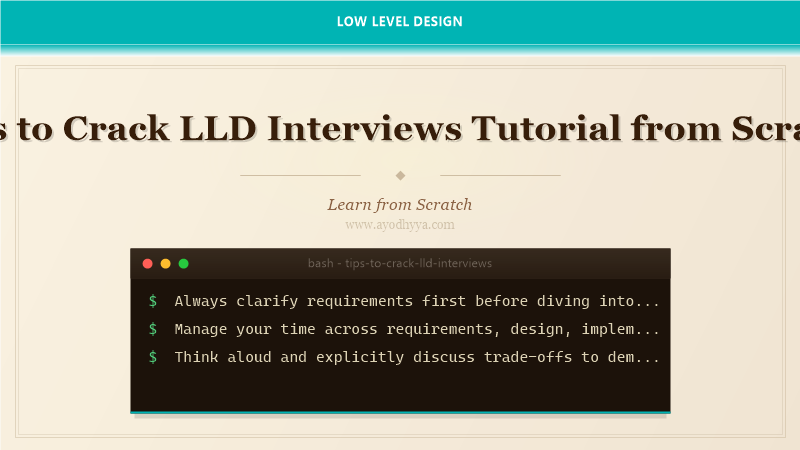
Cracking low-level design interviews requires more than just knowing design patterns and OOP principles. Success depends on your ability to communicate your design decisions, manage time effectively, avoid common pitfalls, and strike the right balance between simplicity and extensibility.
This tutorial covers the most common mistakes candidates make, time management strategies for 45-60 minute interviews, effective communication techniques, and how to navigate trade-off discussions with interviewers.
Common Mistakes to Avoid
Candidates frequently over-engineer solutions by adding unnecessary design patterns, abstract classes, and interfaces before understanding the core problem. Other common mistakes include ignoring edge cases (null values, empty states, concurrent access), writing overly complex code, failing to clarify requirements, and not considering testability of the design.
class CommonMistakes {
  static overEngineering() {
    console.log("Keep it simple. Add patterns only when needed.");
  }
  static ignoringEdgeCases() {
    const items = null;
    if (items && items.length > 0) { items.forEach(item => console.log(item)); }
  }
  static notClarifying() {
    console.log("Always clarify requirements before coding.");
    console.log("Ask: What are the core features? Any constraints?");
  }
  static complexCode() {
    return {
      avoid: "Writing production-quality code in interviews",
      instead: "Focus on design clarity and correctness"
    };
  }
}

CommonMistakes.overEngineering();
CommonMistakes.ignoringEdgeCases();
CommonMistakes.notClarifying();
Time Management Strategies
In a typical 45-minute interview, allocate 5-7 minutes for requirements clarification, 10-12 minutes for identifying core entities and class design, 15-20 minutes for implementing key methods and relationships, 5-8 minutes for discussing design patterns and trade-offs, and 3-5 minutes for summarizing and discussing extensibility.
class TimeManager {
  constructor(totalMinutes) {
    this.totalMinutes = totalMinutes;
    this.phases = [];
    this.elapsed = 0;
  }
  addPhase(name, duration) {
    this.phases.push({ name, duration, start: this.elapsed });
    this.elapsed += duration;
  }
  validate() {
    const total = this.phases.reduce((s, p) => s + p.duration, 0);
    return total <= this.totalMinutes;
  }
  printSchedule() {
    console.log("Interview Timeline:");
    for (const phase of this.phases) {
      const endMin = phase.start + phase.duration;
      console.log("  " + phase.start + "-" + endMin + "min: " + phase.name);
    }
  }
}

const interview = new TimeManager(45);
interview.addPhase("Requirements clarification", 7);
interview.addPhase("Entity identification and class design", 12);
interview.addPhase("Implementation of key methods", 18);
interview.addPhase("Design patterns and trade-offs discussion", 5);
interview.addPhase("Summary and extensibility", 3);
interview.printSchedule();
console.log("Valid: " + interview.validate());
Communication and Trade-off Discussions
Think aloud throughout the interview. Explain why you chose one approach over another, discuss alternative designs, and acknowledge trade-offs explicitly. Use structured language: If we prioritize performance over memory, we would choose X. However, if readability and maintainability are more important, Y is better. This demonstrates engineering maturity.
class TradeOffAnalyzer {
  constructor() { this.options = []; }
  addOption(name, pros, cons) { this.options.push({ name, pros, cons }); }

  compare(priorities) {
    for (const option of this.options) {
      console.log("");
      console.log("Option: " + option.name);
      console.log("  Pros:");
      option.pros.forEach(p => console.log("    + " + p));
      console.log("  Cons:");
      option.cons.forEach(c => console.log("    - " + c));
    }

    const best = this.options.reduce((a, b) => {
      const aScore = priorities.reduce((s, p) =>
        s + (a.pros.includes(p) ? 1 : a.cons.includes(p) ? -1 : 0), 0);
      const bScore = priorities.reduce((s, p) =>
        s + (b.pros.includes(p) ? 1 : b.cons.includes(p) ? -1 : 0), 0);
      return aScore >= bScore ? a : b;
    });

    console.log("");
    console.log("Recommended: " + best.name + " based on priorities: [" + priorities + "]");
    return best;
  }
}

const analyzer = new TradeOffAnalyzer();
analyzer.addOption("Singleton Pattern",
  ["Global access", "Single instance guarantee"],
  ["Tight coupling", "Difficult to test", "Concurrency issues"]);
analyzer.addOption("Dependency Injection",
  ["Testable", "Loose coupling", "Configurable"],
  ["More boilerplate", "Complex container setup"]);

analyzer.compare(["testability", "loose coupling"]);
Frequently Asked Questions
What is the single most important rule for LLD interviews?
Clarify requirements before writing a single line of code. Most failures in LLD interviews come from solving the wrong problem or making incorrect assumptions about what the system should do. Always confirm scope, entities, and constraints upfront.
How do I handle feedback or suggestions from the interviewer?
Treat feedback as a collaborative signal, not a criticism. Acknowledge the suggestion, integrate it if it improves the design, and explain why you agree or disagree. Interviewers are often testing your ability to collaborate and incorporate feedback gracefully.
Should I use UML diagrams during the interview?
Drawing a simple class diagram or sequence diagram can significantly improve communication. Use it to clarify entity relationships and interaction flows. You do not need formal UML notation; a rough sketch with boxes and arrows is often sufficient.
How important is code correctness vs design quality?
Design quality matters more than perfect syntax. A well-structured design with clean class boundaries and appropriate design patterns will score higher than syntactically perfect code that is poorly designed. That said, your code should be logically correct and runnable in principle.
Originally published on Ayodhyyya. Last updated June 1, 2026.