LlamaIndex Tutorial: Master Data Indexing and RAG (2026)
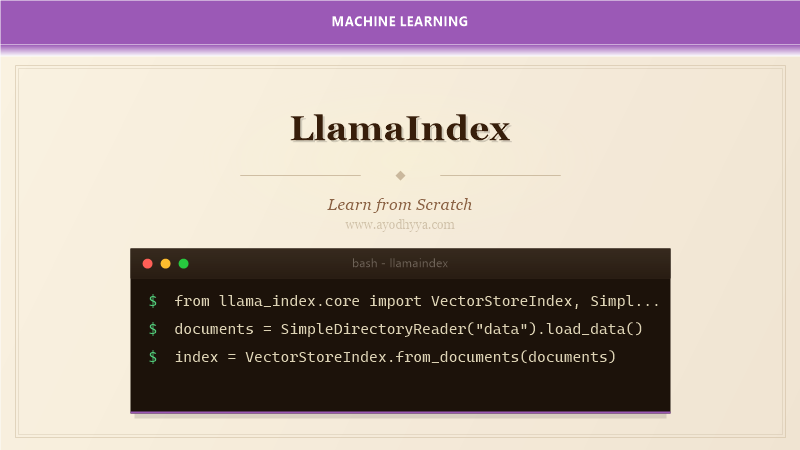
LlamaIndex provides a complete data framework for ingesting, indexing, and querying your data with LLMs. It handles document parsing, chunking, embedding, and retrieval.
By 2026, LlamaIndex has become the standard library for building RAG applications with enterprise-grade performance.
Installation and Document Loading
SimpleDirectoryReader is the easiest way to start. Point it at a folder and it loads everything.
For production, use specific readers that preserve metadata like page numbers and section headings.
pip install llama-index\nfrom llama_index.core import SimpleDirectoryReader\ndocuments = SimpleDirectoryReader("./data").load_data()Text Splitting and Node Parsing
LlamaIndex splits documents into nodes with metadata. The SentenceSplitter respects sentence boundaries.
Default chunk size of 1024 tokens with 200 overlap works well for most use cases.
from llama_index.core.node_parser import SentenceSplitter\nparser = SentenceSplitter(chunk_size=1024, chunk_overlap=200)\nnodes = parser.get_nodes_from_documents(documents)Building Vector Indexes
The vector index embeds nodes into high-dimensional space and retrieves by semantic similarity. LlamaIndex supports OpenAI, Cohere, Hugging Face, and local models.
The choice of embedding model significantly impacts retrieval quality.
from llama_index.core import VectorStoreIndex\nindex = VectorStoreIndex.from_documents(documents, embed_model=embed_model)Query Engines and Retrieval Strategies
The query engine is the interface for asking questions. Hybrid search combining vector and keyword search improves retrieval quality.
LlamaIndex makes it easy to experiment with different retrieval configurations.
query_engine = index.as_query_engine(similarity_top_k=5)\nresponse = query_engine.query("What is LlamaIndex?")Knowledge Graph Indexes
KnowledgeGraphIndex extracts entities and relationships from documents for structured queries.
I used it to extract company names, products, and partnerships from thousands of news articles.
from llama_index.core import KnowledgeGraphIndex\nkg_index = KnowledgeGraphIndex.from_documents(documents)Production Deployment and Caching
Indexes can be persisted to disk and reloaded without re-embedding. LlamaIndex supports insert, update, and delete operations.
Implement two-tier caching for embeddings and query responses to reduce costs.
index.storage_context.persist("./storage")\nfrom llama_index.core import StorageContext, load_index_from_storage\nloaded_index = load_index_from_storage(StorageContext.from_defaults(persist_dir="./storage"))Frequently Asked Questions
Difference between LlamaIndex and LangChain?
LlamaIndex specializes in data indexing and retrieval. LangChain focuses on chains and agents. Many use both.
Can LlamaIndex handle images?
Yes, through multi-modal support. Images can be processed with vision models.
How does it compare to vector databases?
LlamaIndex is a framework using vector databases as a backend. It adds document loading, chunking, and query synthesis.
What embedding model should I use?
Use OpenAI text-embedding-3-small for cost or text-embedding-3-large for quality. For local, use BAAI/bge-large-en-v1.5.
Originally published on Ayodhyyya. Last updated June 1, 2026.