SharePoint Tutorial: Learn Collaboration from Scratch (2026)
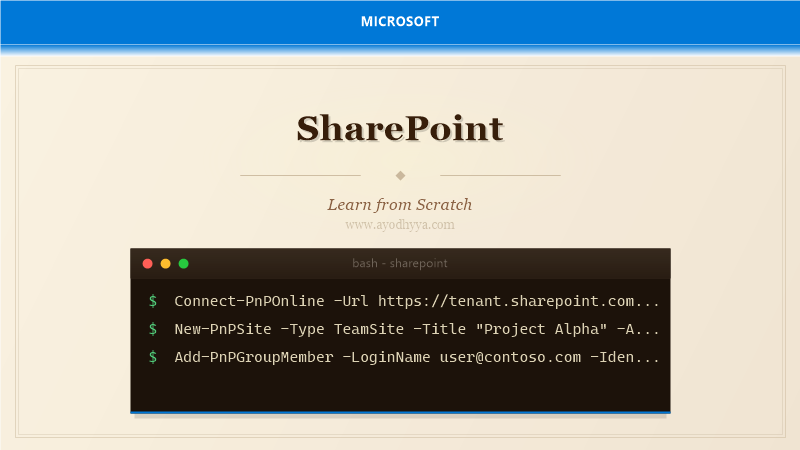
I walked into my first SharePoint project thinking it was just a document library with a web interface. Two months later, I was building custom web parts, designing workflow associations, and explaining to stakeholders why their InfoPath form was not going to work in modern mode. SharePoint is deceptively simple on the surface — anyone can create a site and upload files — but its real power lies in the platform capabilities: content management, process automation, enterprise search, and integration with the broader Microsoft 365 ecosystem.
SharePoint is Microsoft's web-based collaboration platform that integrates with Microsoft 365. It enables organizations to create intranet portals, manage documents with version control, automate business processes with Power Automate, and build custom solutions with SPFx. Whether you are setting up a team site for a small department or architecting a global intranet for 50,000 users, SharePoint provides the tools to match your ambition.
Site Architecture: Team Sites, Communication Sites, and Hubs
SharePoint Online offers two primary site types: Team sites and Communication sites. Team sites are designed for collaboration — they include a connected Microsoft 365 Group, shared mailbox, calendar, and Planner. Every member contributes content. Communication sites are read-centric publishing platforms for broadcasting information to a wider audience, like an intranet homepage or HR portal.
Hub sites connect related sites under a common navigation, branding, and search scope. A single hub can associate up to 2,000 sites. Global navigation appears consistently across all associated sites. Hub site permissions and governance should be planned before rollout to avoid organizational sprawl.
Connect-PnPOnline -Url https://tenant-admin.sharepoint.com -Interactive
New-PnPSite -Type TeamSite -Title "Marketing Department" -Alias marketing -Description "Marketing team collaboration site"
Register-PnPHubSite -Site https://tenant.sharepoint.com/sites/marketing

Set-PnPHomePage -Path "/sites/marketing/SitePages/Home.aspx"
Document Management: Libraries, Versioning, and Metadata
Document libraries are the heart of SharePoint content management. Beyond simply storing files, libraries support versioning (major, minor, and draft approval), check-in/check-out, content approval workflows, and co-authoring. Custom columns extend beyond default metadata. Managed Metadata columns connect to a central term store, ensuring consistent tagging across the organization.
Content types define reusable collections of columns, workflows, and templates. A Contract content type might include columns for Expiration Date, Vendor Name, and Contract Value. Content types can be associated with multiple libraries across different sites, ensuring consistent metadata regardless of where a document is stored.
Add-PnPContentType -Name "Contract" -Group "Business" -Description "Corporate contract documents"
Add-PnPField -DisplayName "ExpirationDate" -InternalName "ExpirationDate" -Type DateTime -Group "Contract Fields"
Add-PnPContentTypeField -ContentType "Contract" -Field "ExpirationDate"

New-PnPList -Title "Contracts" -Template DocumentLibrary
Set-PnPList -Identity "Contracts" -EnableVersioning $true -MajorVersionLimit 10
SharePoint Framework (SPFx) and Custom Web Parts
The SharePoint Framework (SPFx) is the modern development model for building SharePoint customizations. SPFx web parts run in the browser using JavaScript/TypeScript and React, Angular, or plain JavaScript. Unlike older full-trust solutions that required server-side code, SPFx solutions are client-side, deployable as packages (sppkg) uploaded to the tenant App Catalog.
An SPFx web part is essentially a single-page application embedded in a SharePoint page. The build toolchain uses Node.js, Gulp, and Webpack. SPFx extensions — application customizers, field customizers, and command sets — extend SharePoint beyond page-level customizations.
yo @microsoft/sharepoint
# Select: WebPart, React, No framework

gulp serve --nobrowser

export default class HelloWorldWebPart extends BaseClientSideWebPart {
  public render(): void {
    this.domElement.innerHTML = `

        ${this.properties.description}
        Welcome to SharePoint Framework!
      `;
  }
}
Power Automate and Workflow Automation
Power Automate integrates deeply with SharePoint to automate business processes without writing code. Flows trigger on SharePoint events — item created, modified, or deleted — and execute actions across Microsoft 365 services. An approval workflow might start when a new expense report is added, email the manager, update a status column, and save the approved PDF to OneDrive.
Classic SharePoint workflows (SharePoint 2013 Workflow Platform) still work but are deprecated. All new development should use Power Automate. The Dataverse provides a scalable data platform for complex multi-step business processes.
{
    "triggers": {
        "WhenAnItemIsCreated": {
            "type": "SharePoint.WhenAnItemIsCreated",
            "inputs": {
                "siteAddress": "https://tenant.sharepoint.com/sites/expenses",
                "listName": "Expense Reports"
            }
        }
    },
    "actions": {
        "StartApproval": {
            "type": "Approval.StartWaitingForApproval",
            "inputs": {
                "approvalType": "FirstToRespond",
                "assignedTo": "@{triggerOutputs()?['body/ManagerEmail']}",
                "itemLink": "@{triggerOutputs()?['body/WebLink']}"
            }
        }
    }
}
Search, Managed Properties, and Result Sources
SharePoint Search is powered by the Microsoft Search platform in Microsoft 365. Content is crawled from SharePoint sites, OneDrive, Exchange, and external sources. The search schema defines crawled properties and managed properties. Managed properties can be configured as searchable, queryable, retrievable, or refinable.
Result sources define where to search and how to rank results. Query rules modify search behavior based on user intent — promote results when someone searches for vacation policy or IT support. For large enterprises, search customization is critical for helping users find the right content among millions of documents.
Search-PnPSearch -Query "contenttype:contract AND expirationdate<2026-01-01" -All

Set-PnPSearchManagedProperty -Name "ContractValue" -Type Decimal -Searchable $true -Queryable $true -Retrievable $true

Add-PnPSearchResultSource -Name "Contract Search" -Owner Web -ProviderId "Fa03bcdc-5f97-4ae2-abb0-64cfba036525" -Description "Search only contract libraries" -QueryTransform "{searchTerms} contenttype:contract"
Governance, Permissions, and Security
SharePoint permissions follow a hierarchical model: Site Collection -> Site -> List/Library -> Item/Folder. SharePoint groups (Owners, Members, Visitors) map to permission levels (Full Control, Edit, Contribute, Read). For large organizations, Azure AD security groups are preferred over individual user assignments.
Governance should address site provisioning, naming conventions, storage quotas, retention policies, and site lifecycle. SharePoint Admin Center provides reports on site usage and storage. Data Loss Prevention policies prevent sensitive information from being shared externally.
Add-PnPGroup -Identity "HR Managers"
Add-PnPGroupMember -LoginName manager@contoso.com -Identity "HR Managers"
Set-PnPListPermission -Identity "Contracts" -User "External Auditors" -AddRole "Read" -BreakInheritance -CopyRoleAssignments $false

Set-PnPTenantSite -Url https://tenant.sharepoint.com/sites/hr -SharingCapability ExternalUserSharingOnly -StorageQuota 10240
Frequently Asked Questions
What is the difference between SharePoint Online and SharePoint Server?
SharePoint Online is part of Microsoft 365, managed by Microsoft with automatic updates. SharePoint Server is on-premises software you install and manage, now in SharePoint Server Subscription Edition.
Do I need to know programming to use SharePoint?
No. Basic usage requires no coding. For customizations, SPFx requires JavaScript/TypeScript, Power Automate is low-code, and PowerShell is useful for administration.
What is the SharePoint Framework (SPFx)?
SPFx is the modern, client-side development model for SharePoint. It uses open-source toolchains (Node, Gulp, Webpack, React) and produces packages deployable to the App Catalog.
How do I migrate content to SharePoint Online?
Use the SharePoint Migration Tool (SPMT) for basic migrations, or third-party tools like Sharegate. Plan metadata mapping, conduct pilot migrations, and validate permissions before full cutover.
Originally published on Ayodhyyya. Last updated June 1, 2026.