C++ Tutorial: Learn OOP Language from Scratch (2026)
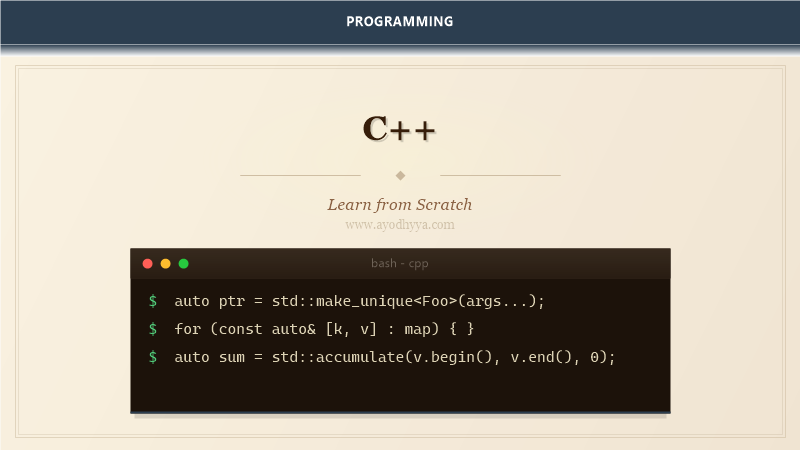
I have shipped C++ in game engines, trading systems, and CAD software. The language's core promise — zero-cost abstractions — means you get high-level expressiveness without sacrificing performance. Modern C++ (C++17 and later) feels like a different language from the C++98 I started with, and it is far safer.
This tutorial emphasizes the idioms that actually matter: RAII, templates, the STL, and move semantics. These are the tools that separate production C++ from academic examples.
RAII
RAII ties resource lifetime to object lifetime: the constructor acquires, the destructor releases. This makes exception safety almost automatic. Every production codebase I have seen relies on RAII for mutexes, file handles, and heap memory. Use std::unique_ptr for exclusive ownership and std::shared_ptr for shared ownership.
class Lock {
    std::mutex& m;
public:
    Lock(std::mutex& m) : m(m) { m.lock(); }
    ~Lock() { m.unlock(); }
};

void critical() {
    Lock g(global_mutex);
    // auto-unlocked on exit
}
Templates
Templates enable compile-time polymorphism. The compiler generates specialized code for each set of template arguments. C++20 concepts make constraints readable: requires std::integral is clearer than SFINAE tricks. Templates are Turing-complete but use them for genericity, not compile-time computation.
template
auto max(T a, T b) -> T {
    return a > b ? a : b;
}

template
void serialize(const T& v) {
    if constexpr (std::is_integral_v)
        write_int(v);
    else
        write_json(v);
}
STL Containers
vector is the default sequence: contiguous memory makes iteration cache-friendly. map gives O(log n) lookup; unordered_map gives average O(1). Pair containers with STL algorithms via iterators. std::sort, std::find_if, and std::accumulate replace error-prone handwritten loops.
std::vector v = {4, 1, 3, 5, 2};
std::sort(v.begin(), v.end());

auto it = std::find_if(v.begin(), v.end(),
    [](int x) { return x > 3; });

int sum = std::accumulate(
    v.begin(), v.end(), 0);
Virtual Dispatch
Virtual functions enable runtime polymorphism through a vtable. Each object carries a hidden vptr to its class's vtable. Dispatch costs one indirect call and prevents inlining. Mark overrides with override to catch signature mismatches at compile time. For hot paths, consider CRTP as a static alternative.
class Shape {
public:
    virtual double area() const = 0;
    virtual ~Shape() = default;
};

class Circle : public Shape {
    double r;
public:
    Circle(double r) : r(r) {}
    double area() const override {
        return 3.14159 * r * r;
    }
};
Move Semantics
Move semantics transfer resources from temporaries without copying. The move constructor steals pointers and leaves the source in a valid-but-unspecified state. This eliminates deep copies when returning large objects. Follow the Rule of Five: if you define any of destructor, copy ctor, copy assign, also define the move counterparts.
class Buffer {
    char* data;
    size_t size;
public:
    Buffer(Buffer&& o) noexcept
        : data(o.data), size(o.size) {
        o.data = nullptr;
        o.size = 0;
    }
    Buffer& operator=(Buffer&& o) noexcept {
        delete[] data;
        data = o.data;
        size = o.size;
        o.data = nullptr;
        return *this;
    }
};
Lambdas
Lambdas are anonymous function objects. The capture clause specifies accessed locals: [=] copies, [&] references. Default capture can dangle; I prefer explicit captures. Lambdas are essential for STL algorithms, thread launch, and callbacks. Generic lambdas with auto work like templates.
std::vector v = {1, 2, 3, 4};
int scale = 10;

std::transform(v.begin(), v.end(), v.begin(),
    [scale](int x) { return x * scale; });
Frequently Asked Questions
Struct vs class?
Members default to public in struct, private in class. They are otherwise identical.
When use virtual inheritance?
For the diamond problem: when a class inherits from two classes sharing a common base and you want one base instance.
Why vector over list?
vector is contiguous and cache-friendly. list allocates per-node, causing cache misses on traversal.
Most common C++ mistake?
Undefined behavior. The compiler assumes UB never happens, so a working debug build may break with optimizations.
Originally published on Ayodhyyya. Last updated June 1, 2026.