Scala Tutorial: Learn Functional JVM from Scratch (2026)
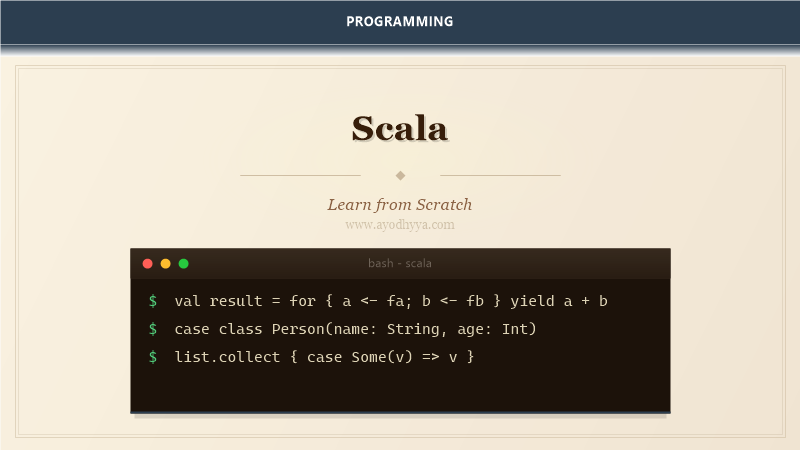
Scala bridged the gap between object-oriented and functional programming on the JVM. I have used it for data pipelines with Apache Spark, microservices with Akka HTTP, and financial analytics systems. Scala's type system is powerful enough to encode business rules at compile time while remaining expressive enough for everyday code.
The language introduced me to functional programming concepts — immutability by default, referential transparency, and algebraic data types — in a way that was practical, not academic.
Case Classes
Case classes are immutable by default and provide equals, hashCode, toString, copy, and pattern matching support automatically. They are Scala's answer to DTOs and value objects. Declare with case class followed by constructor parameters. The copy method creates a modified copy without mutating the original.
case class User(id: Long, name: String, email: String)

val u1 = User(1, "Alice", "a@b.com")
val u2 = u1.copy(name = "Bob")

u1 match {
  case User(id, _, _) => println(s"id: $id")
}
Pattern Matching
Pattern matching destructures values and dispatches based on shape. It is exhaustive for sealed types. Match on case classes, tuples, collections, and custom extractors. The compiler warns about non-exhaustive matches. Use pattern matching instead of instanceof checks or visitor patterns.
sealed trait Tree
case class Leaf(value: Int) extends Tree
case class Node(left: Tree, right: Tree) extends Tree

def sum(t: Tree): Int = t match {
  case Leaf(v) => v
  case Node(l, r) => sum(l) + sum(r)
}

// Collection destructuring
val list = List(1, 2, 3)
list match {
  case head :: tail => println(s"$head, $tail")
  case Nil => println("empty")
}
Implicits
Implicits let the compiler supply arguments automatically. They are used for type classes, extension methods, and context parameters. Scala 3 uses given/using to replace implicit parameters with clearer syntax. Implicit conversions can be dangerous; prefer extension methods via implicit classes or extension in Scala 3.
trait Show[T] {
  def show(t: T): String
}

object Show {
  given Show[Int] = (i: Int) => i.toString
  given Show[String] = (s: String) => s
}

def print[T: Show](t: T): Unit = {
  val ev = summon[Show[T]]
  println(ev.show(t))
}

// Scala 3 extension method
extension (s: String) {
  def greet: String = s"Hello, $s"
}
println("Alice".greet)
Futures
Future[T] represents a computation that may produce a value later. Use Future.apply to start async work; it runs on an implicit ExecutionContext. Transform with map, flatMap, and filter. Recover from failures with recover and recoverWith. Future.sequence turns a list of futures into a future of a list.
import scala.concurrent.{Future, Await}
import scala.concurrent.ExecutionContext.Implicits.global
import scala.concurrent.duration.*

def fetch(url: String): Future[String] = Future {
  scala.io.Source.fromURL(url).mkString
}

val results = Future.sequence(
  List(fetch("https://a.com"), fetch("https://b.com"))
)

val content = Await.result(results, 10.seconds)
For-Comprehensions
For-comprehensions are syntactic sugar for chains of map, flatMap, and filter. They work with any type that defines these methods: Option, Future, List, Either, or custom monads. <- extracts values; if guards filter; yield collects results. For-comprehensions often make async code read like sequential code.
case class User(id: Int, name: String)
def findUser(id: Int): Option[User] = ???
def getEmail(user: User): Option[String] = ???

val email: Option[String] = for {
  user <- findUser(42)
  email <- getEmail(user)
  if email.contains("@")
} yield email

// With Futures
val combined: Future[String] = for {
  a <- fetch("https://a.com")
  b <- fetch("https://b.com")
} yield a + b
Companion Objects
Companion objects hold static methods and factory methods for a class. They share private access with the class. apply methods in companions enable constructor-like syntax without new. Companions are where you place unapply for custom pattern matching and instances for type classes.
class User private(val id: Long, val name: String)

object User {
  def apply(id: Long, name: String): User =
    new User(id, name)

  def fromCSV(line: String): Option[User] = {
    line.split(",") match {
      case Array(id, name) =>
        Some(new User(id.toLong, name.trim))
      case _ => None
    }
  }

  def unapply(u: User): Option[(Long, String)] =
    Some((u.id, u.name))
}

val u = User(1, "Alice") // calls User.apply
Frequently Asked Questions
Scala 2 vs Scala 3?
Scala 3 simplifies the language: fewer symbols, given/using instead of implicits, enum instead of sealed trait hierarchy, and optional braces.
What is an ADT?
Algebraic Data Type: a type formed by combining other types (product = case class, sum = sealed trait hierarchy). Core to functional modeling.
When to use Future vs IO?
Future is eagerly evaluated and memoized. IO (Cats Effect, ZIO) is lazy, referentially transparent, and supports cancellation.
What is a type class?
A pattern using traits and implicits for ad-hoc polymorphism. Example: Show, Eq, Order. Scala 3's given/using makes this cleaner.
Originally published on Ayodhyyya. Last updated June 1, 2026.